CHRISTMAS COMES, ALWAYS TOO EARLY
Oktoberfest is done, but the smell of beer, roast chicken and regrettable decisions still hovers over Munich; the Lederhosen have barely made it back into the wardrobe and the city is still recovering from its collective hangover. Naturally, this is the moment to start thinking about Christmas.
There is some logic to this. Munich is very good at moving from one seasonal ritual straight into the next. And by the time Germans begin taking Christmas seriously, everyone else should have already booked their flights. While Munich and Berlin agree on many of the basic ingredients for Christmas markets—wooden huts, mulled wine (Glühwein), sausages, things involving cinnamon—they approach the festive season slightly differently. Munich tends towards the traditional and suspiciously perfect. Berlin, predictably, cannot agree on what Christmas is supposed to look like in the first place.
So here it is, our guide to Christmas markets in both cities — including where to embrace the cliché, where to escape it, and when it might be wiser to simply go to a bar instead.
MUNICH: RESISTANCE IS FUTILE
Munich has been rehearsing Christmas since approximately 1158. Not quite. But the city’s main Christkindlmarkt has roots going back to the Middle Ages and takes these things seriously. The original Nikolaus markets can be traced back centuries; since 1972, the principal version has occupied Marienplatz, beneath the neo-Gothic Neues Rathaus. This year it runs from November 20th until Christmas Eve.
The Christkindlmarkt at Marienplatz is the obvious place to start, which is precisely why most locals will tell you not to start there. Ignore them. Yes, it gets crowded. Yes, you may find yourself trapped behind a family discussing Christmas-tree ornaments at considerable length. But there are moments when tourism and residential life overlap nicely, and standing under several thousand lights in front of the Rathaus with a hot drink is one of them.
Around the corner is the Kripperlmarkt at St Peter’s. Bavaria has always understood that if you are going to do Catholicism, you might as well go all in. And here you can buy practically everything required to construct Bethlehem at home: Mary, Joseph, oxen, shepherds, angels, architectural components and, presumably, enough livestock to create zoning problems.
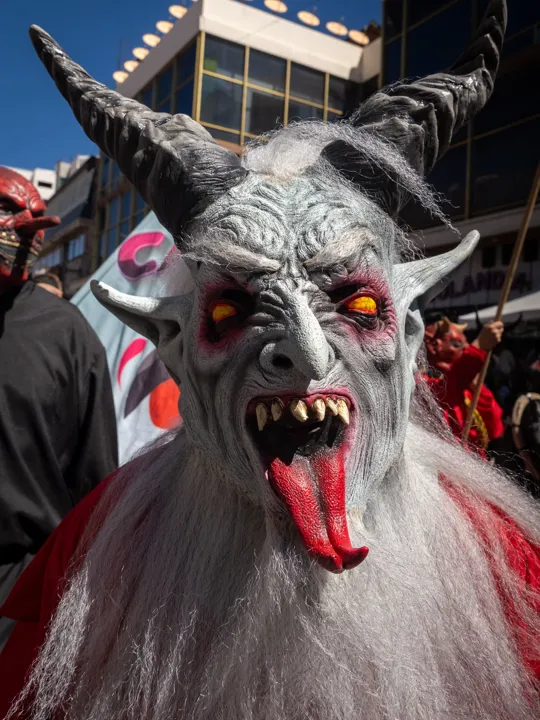
There is another reason to be in the old town on the right day (in 2026: December 13th) Krampus. Honestly, it’s a bit scary: Around 300 Krampusse, Perchten and other creatures take over the centre. For visitors unfamiliar with the custom, imagine discovering that Santa Claus has outsourced disciplinary matters to a heavy-metal band from the Alps. The costumes are magnificent, the bells deafening and the whole thing a useful corrective to the idea that German Christmas is entirely about harmless wooden angels.
CHRISTMAS, CIRCA 1350
The medieval Christmas market at Wittelsbacher Platz is what happens when Munich’s general weakness for historical reenactment is fueled by Glühwein. Merchants wear period costumes, meat cooks over open fires and beverages have names like Drachenglut. Still, it works. Munich has a curious talent for turning invented tradition into something that feels completely natural. This is, after all, a city where hundreds-thousands of people voluntarily dress in regional clothing to drink beer from one-litre glasses every late summer and consider this normal behaviour. Compared with Oktoberfest, pretending to be a medieval blacksmith for three weeks is relatively restrained.
FIRE, RUM AND OTHER SOLUTIONS
For something less medieval but hardly more restrained, there is Feuerzangenbowle: red wine, spices, rum and a large block of sugar set on fire above it. The drink owes much of its cultural immortality to “Die Feuerzangenbowle”, the 1944 film starring Heinz Rühmann, which generations of German students have watched communally while attempting to reproduce the beverage. Munich has simply scaled up the principle. Its Feuerzangenbowle is served from an enormous cauldron crowned with flames — this year behind the Schrannenhalle rather than at its usual Isartor location.
From there, head towards Glockenbachviertel for a different kind of tradition. Pink Christmas at Stephansplatz is Munich’s queer Christmas market, smaller and considerably more camp than Marienplatz. The neighbourhood around it has long been one of the centres of gay life in the city, and the market supplies what the traditional Christkindlmarkt lacks: pop music, drag and the possibility that somebody has actually thought about the lighting.
A VILLAGE HIDDEN IN NEUKÖLLN
Alt-Rixdorf is perhaps the more interesting contradiction. Today it sits in Neukölln, but Richardplatz still contains traces of the old village of Rixdorf: cobblestones, historic buildings, an old smithy and a church. For one weekend in December the square is lit largely by oil and gas lamps, and around 200 charitable organisations and associations run the stalls.
This produces the rare Berlin phenomenon of something being both picturesque and difficult to be cynical about. It is also a useful reminder that Berlin is not one city but many former villages, towns, centres and ideological experiments that have gradually collided with one another. Christmas simply adds fairy lights.
Nearby is Holy Shit Shopping, the design market whose name tells you most of what you need to know about Berlin’s relationship with Christmas tradition. If Marienplatz asks you to buy a hand-carved angel, Berlin would prefer to sell you a risograph, a ceramic object you cannot identify and a tote bag produced by someone with an excellent typeface. Both are valid gifts.
CHRISTMAS IN THE WEST
For another Berlin, go west. KaDeWe opened in 1907 and built its reputation by offering Berliners things from elsewhere: Parisian fashion, exotic fruit, luxury goods, the world condensed into a department store. During the Cold War it became even more symbolically loaded, a giant shop window of Western abundance in an island city.
After the Wall fell, up to 200,000 people reportedly entered the store on particularly busy days. Nothing says “the end of history” quite like going shopping. At Christmas, KaDeWe makes an excellent secular cathedral. Go upstairs to the food hall, look at things you do not need, buy something edible and call it cultural research. And if all that West Berlin history makes you want something less polished, David Bowie’s former flat at Hauptstraße 155 is only a short journey away in Schöneberg. Bowie lived there with Iggy Pop in the late 1970s, during the period that produced hisBerlin records. There is no particular Christmas connection–not everything needs one anyhow–and one of Berlin’s finest Döner shops is next door.
ADDENDUM: A GENERAL SURVIVAL GUIDE FOR GERMAN CHRISTMAS
1. Do not go to every Christmas market. This is not a competitive sport. And ifwinter happens to behave like winter—rather than giving us twelve degrees in December—there is always a warm beer hall somewhere close which you can use as an emergency shelter: Enter cold, remove coat, order beer, reconsider Christmas.
2. A word of warning in this context: Glühwein follows a peculiar mathematical principle whereby the first one seems medicinal, the second festive and the third retrospectively unnecessary. Drink water. Or go to the beer hall, where at least everyone knows what they are doing.
3. Pfand means deposit: the ceramic mug your Glühwein arrives in has not automatically become your souvenir. Return it and get your money back, or keep it and accept that you have just bought a mug while mildly drunk.
4. Eat something. Bratwurst is traditional, roasted almonds are almost compulsory, and anything whose German name you cannot immediately translate is probably worth investigating.
5. Remember that the Christmas market is not really the destination. It is an excuse to be outside in a German city at precisely the time of year when common sense suggests going indoors.
Disclaimer: If you are reading this in early November, I apologise for Christmas-maxxing too soon. If you are reading it in December and haven’t booked anything: I tried to warn you!
Come join the Christmas cheer. Book to stay in Berlin and Munich directly on our website, where you’ll always find the best rates.
Share this article
Last Updated: Nov 5, 2026